

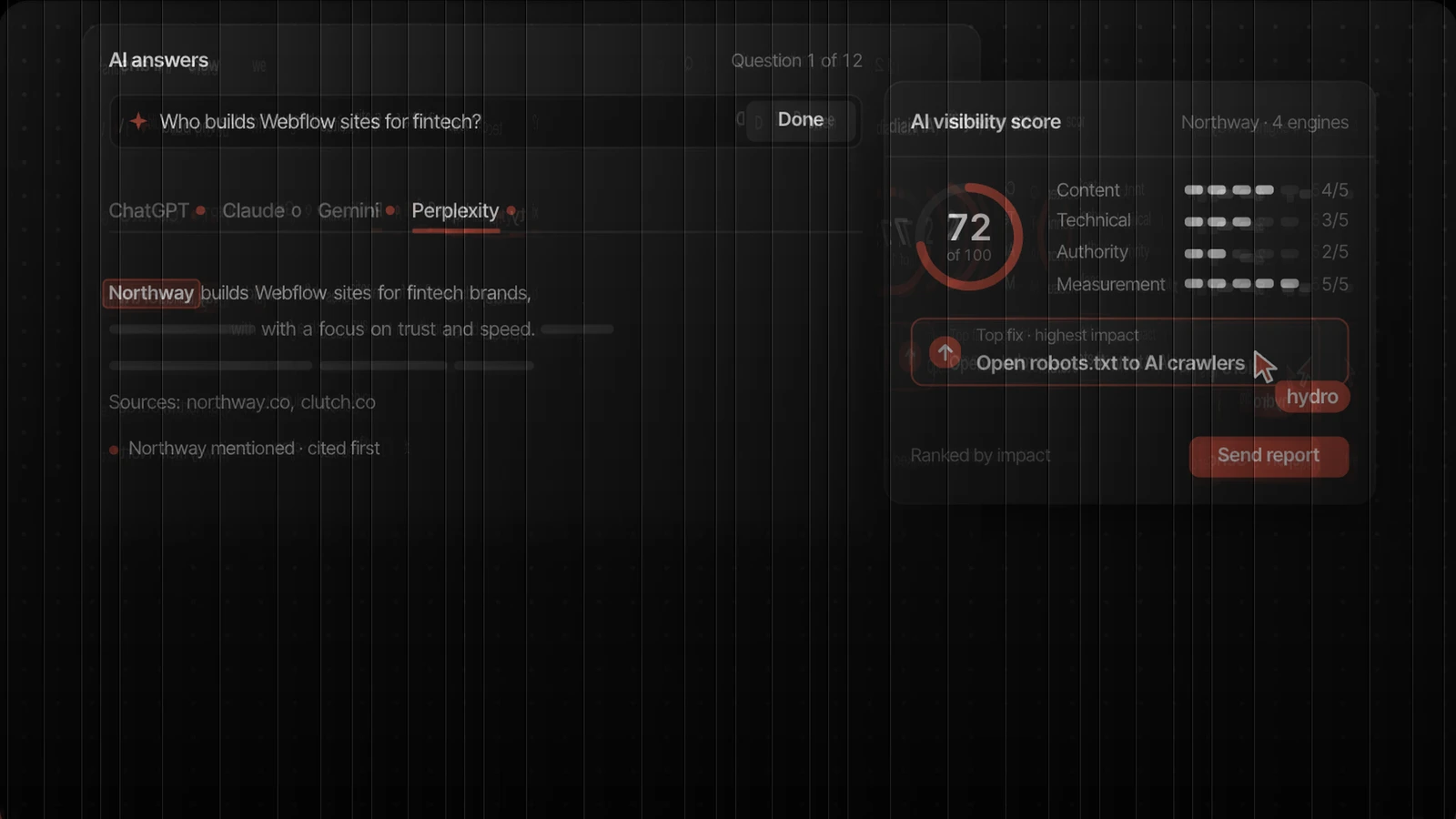
Most websites aren't ready for AI search yet. Across 32 AI Visibility Checks we ran between October and November 2026, the average score was 47.5 out of 100, half the sites scored under 50, and none reached 70. The weakest area wasn't technical at all: it was authority, the proof elsewhere on the web that a business is who it says it is.
We run two free resources that read a live website and score it: the AI Visibility Check, which looks at how ready a site is for answer engines, and the Website Health Check, which runs fifteen checks on speed, security, findability and tracking. Every run is stored, so we can count what we find. This report adds up 132 runs across 127 different websites, with no site or requester named.
Below are the method, eight findings with what to check on your own site, and the fixes that came up most. For background, read how to get your brand recommended by ChatGPT, Claude and Perplexity or what llms.txt is and whether you need one.
Answer engine optimisation (AEO) is the work of making a business easy for AI assistants to read, describe accurately and recommend. Some people call it generative engine optimisation, AI search optimisation or LLM SEO. The aim is the same: when a buyer asks ChatGPT, Claude, Gemini or Perplexity who to work with, your name comes up and the description is right.
A search engine ranks pages; an answer engine writes a reply, using only what it can reach, read and trust. So our AI Visibility Check scores four pillars: content (do your pages answer buyers' questions), technical (can machines read the site), authority (does the rest of the web back you up) and measurement (can you see what AI sends you).
Both checks run on a live site the moment someone submits a business email and a website on hydro.website. The numbers below come from read-only queries on the stored results.
The technical facts (robots.txt, llms.txt, sitemap, schema, headings, analytics) are read straight from each site. The content and authority pillars are graded by an AI model with live web search, so treat those two as an informed estimate. The sites are the ones people chose to submit, some by businesses and some by agencies checking a client's, so they aren't a random sample of the web. These are our own AEO statistics, not an industry census.
What we found: the 32 AI Visibility Check scores ran from 25 to 65, with an average and a median of 47.5. Four sites scored 25 to 35, 12 scored 40 to 45, 11 scored 50 to 55 and five scored 60 to 65. Not one reached 70.
What it means: we score each pillar on five levels, from Found to Recommended, and most pillar scores sat at level two or three. AI can find these sites and roughly describe them, but nothing about them makes an engine quote them as a source or name them first.
When it may not apply: a business that wins all its work through referrals may not need AI to recommend it yet.
What to check: ask ChatGPT, Claude and Perplexity who they'd recommend for your service, then what your company does, and compare the answers with your site.
What we found: pillar averages out of 5 were technical 3.06, content 2.56, measurement 2.25 and authority 1.63. Fifteen of the 32 sites (47%) sat at authority level 1, 14 at level 2, three at level 3 and none higher. Of the 160 fixes in the reports, 55 (34%) were authority fixes, more than any other pillar.
What it means: most sites are easier to fix on their own pages than off them. The recommendations show where the gap is: 24 of the 32 reports (75%) told the business to build up reviews, and 22 (69%) recommended mentions in trade press, directories or listings.
When it may not apply: a new business can't manufacture reviews. Start with the clients you have and the directories your buyers use.
What to check: search your company name and see what turns up beyond your own site. If it's only your website and your LinkedIn page, that's what an answer engine sees too.
What we found: asked how an answer engine would describe each business today, our grader judged the result accurate for 10 sites (31%), partly accurate for 17 (53%) and not found for five (16%).
What it means: "partly accurate" usually means AI could name the category but not the specifics: which clients, what results, who it's for.
When it may not apply: if your site states a simple offer in plain words, you may already be in the accurate group.
What to check: read your homepage's first two lines out loud. If they don't say what you do, who for and what makes you the safe choice, AI won't be able to either.
What we found: 17 of the 32 sites (53%) had no llms.txt. Of the 15 that did, 13 were longer than 1,500 characters, enough for a real summary rather than a placeholder. Our checker only counts a file that returns plain text, not a page of HTML, so these are real files.
What it means: llms.txt is a short markdown file that tells AI assistants who you are and where your key pages are. It's a proposal no engine has to follow, so it won't get you recommended on its own, but 14 of the 32 reports listed it among the top five fixes.
When it may not apply: a single-page site gains little from one. If a redesign is coming, add it at launch.
What to check: open yoursite.com/llms.txt. If you see a 404 or your homepage, you don't have one. Our llms.txt Generator writes one from your own pages for £99, within the hour.
What we found: we test seven AI crawlers in robots.txt: GPTBot, OAI-SearchBot, ChatGPT-User, ClaudeBot, PerplexityBot, Google-Extended and Bingbot. Thirty-one of the 32 sites (97%) let all seven in. One site blocked all seven. Three sites had no robots.txt at all.
What it means: blocked crawlers get a lot of attention in AI SEO articles, but in our data they're rarely the problem. A site that lets every crawler in and still scores 45 has a content and authority problem.
When it may not apply: some hosting and security services block bots before robots.txt is even read. In our Health Check data, four of the seven sites we couldn't read returned a 403 to our checker, even though it visits as an ordinary browser would.
What to check: open yoursite.com/robots.txt and look for "Disallow: /" under any AI crawler's name, then ask your host about firewall and bot settings.
What we found: 6 of the 32 sites (19%) had no schema markup on the homepage. Twenty-three (72%) had Organization or a close variant. Only three (9%) had FAQPage schema, and none had Article or BlogPosting schema on the homepage.
What it means: the basic markup that says who the business is was there on most sites. The markup that helps an assistant lift a direct answer, FAQPage on question-led pages, is rare. FAQ schema came up as a fix in 14 of the 32 reports (44%).
When it may not apply: FAQ schema only helps on pages with real questions and answers.
What to check: run your homepage and service pages through Google's Rich Results Test and see which types it finds.
What we found: 10 of the 32 AI Visibility Check sites had either no H1 (five) or more than one (five). In the Health Check data, "Keep one H1 per page" was the biggest single fix on 17 of the 93 scored sites (18%). Seven of the 32 had no sitemap, and four had no meta description.
What it means: the H1 is how a machine names the page. With none, the page is unnamed; with three, it's unclear which counts. It's one of the easiest fixes on the list.
When it may not apply: our checks read the homepage. Inner pages can have their own heading problems, so check your key service pages too.
What to check: run the free Website Health Check. It counts your H1s, checks title, description, sitemap and schema, and orders the fixes by points lost.
What we found: 9 of the 32 sites (28%) had no analytics we could detect. Six (19%) had an ad platform conversion tag, and only one (3%) sent a lead event when a form was submitted. In the Health Check data, "Install analytics" was the biggest single fix on 19 of the 93 scored sites (20%), more than any other.
What it means: without analytics you can't see visits from chatgpt.com or perplexity.ai, and without lead events you can't tie them to enquiries.
When it may not apply: if every enquiry comes by phone and you ask each caller where they heard of you, you have a rough measure.
What to check: in your analytics, look at referrals from AI assistants over the last 30 days. Then submit your own contact form and confirm it shows up as a conversion.
The Health Check scores fifteen checks out of 100 and ranks every failed check by the points it costs. Across the 93 sites it could read, the average was 82.8, the median 85, the range 48 to 98, and no site scored 100. Nine scored under 70, 21 scored 70 to 79, 43 scored 80 to 89 and 20 scored 90 or above.
This is the fix that cost each site the most points, its top fix:
Seven of the 100 sites couldn't be read at all: four returned a 403, two didn't respond and one returned a 404. Each of those requesters got an email saying we couldn't load the site, rather than a report. None of these checks is Webflow SEO specific: they apply on any platform.
Start with whichever of the four pillars scores lowest, because that's where AI loses track of you. For most sites in our data that's authority, which means reviews, directory profiles and mentions in the press your buyers read. Then make sure the pages themselves answer real questions in their first two lines, and that the technical basics (one H1, a sitemap, schema, llms.txt) are in place.
If your site needs more than fixes, website redesign services are the moment to build answer engine optimisation in from the start. When we built Eluviant's new Webflow site, schema and llms.txt went in at launch, alongside a design system and a CMS their team can update. As a Premium Webflow Partner founded in Manchester, and a B2B web design agency, we've found it's far easier to get the structure right at launch than to fix it after.
The sites in our data aren't failing AI search because they block it. Most are open and marked up with the basics. What they lack is proof elsewhere on the web and pages that answer buyers' questions in plain, specific words. That's where answer engine optimisation does its work, and it's slower than a robots.txt change.
To see where your own site stands, run the free AI Visibility Check or the Website Health Check. If you want the fixes made for you, see our Website Optimisation service, or how we work as an AEO agency every month.
hydro is a Webflow, brand and design partner for B2B businesses, and a Premium Webflow Partner. Founded in Manchester in 2023, we're the web design agency, brand identity agency and Webflow agency behind 200+ B2B customers, rated 4.9 from 57 Google reviews. We design and build brands, Webflow websites, motion, platforms and AI agents, on our Unlimited Plan design subscription or as one-off projects, and most projects take two to four weeks from kickoff to launch. For AI search, that means checking what answer engines can read about you and fixing it every month on our AEO service. Contact us.
Few, in our data. Across 32 AI Visibility Checks, the average score was 47.5 out of 100, half scored under 50 and none reached 70. Most sites can be found and roughly described by AI, but very few are quoted or recommended.
Weak authority. It was the lowest pillar in our data, averaging 1.63 out of 5, and 75% of reports recommended building up reviews. AI wants evidence beyond your own website before it names you.
No. Thirty-one of the 32 sites we checked let all seven AI crawlers we test into robots.txt. Blocking is rarely the problem, though firewalls and bot settings can still stop crawlers before robots.txt is read.
Fifteen of the 32 sites in our AI Visibility Check data had one, and 17 (53%) didn't. Thirteen of the 15 files were longer than 1,500 characters.
SEO helps pages rank in search results, while answer engine optimisation helps AI assistants describe and recommend a business in the answers they write. The foundations overlap: a fast, well-structured site with clear answers does well in both.
There's no ranking to buy or claim, but ChatGPT SEO comes down to making your business easy to recommend. Let AI crawlers in, add schema and an llms.txt, answer buyers' questions on your own pages, and build reviews and mentions elsewhere on the web.
hydro, a Premium Webflow Partner that works as an AEO agency and AI SEO agency, runs a free AI Visibility Check that scores a site out of 100 across content, technical, authority and measurement, with the top five fixes ranked. Its monthly AEO service then asks the main AI engines the questions your buyers ask and fixes what they read, from robots.txt and schema to llms.txt and question-led pages. It makes no promise of a date or a position in AI answers.
Yes. hydro is a Webflow agency that builds schema, llms.txt and clear heading structure into the sites it designs and builds, as it did for Eluviant. Its Website Optimisation service makes the same fixes on an existing site, in Webflow, after an audit.
Real work, real progress and real results
Drop it in the hydro portal or Slack. Every brief gets an ETA the day it arrives.
A designer, a motion designer and a Webflow developer on your brand, with three or four briefs in motion at once.
Comment and approve in one place, with an update from your client success manager every working day.
Files in Figma, pages published on Webflow and motion exported for every channel.