Good waste management website design shows buyers exactly what happens to their material, proves you're compliant and sends each sector to the page that answers its questions. As a brand identity agency and b2b web design agency, we design the brand and the website together, so the same system runs from your homepage to your vans.
Buyers in this sector carry real risk. A manufacturer handing over batteries or pyrotechnics, or a council buying monitoring, needs to trust the process before they pick up the phone. If the site is vague, they call the competitor whose site isn't.
This guide covers the problems waste and environmental businesses face online, three projects we've delivered, what a site in this sector needs, how a project runs and how to choose an agency. If the brand needs work first, see our brand identity service. If it's the site, see Webflow development.
Waste management website design is the planning, design and build of a website for a business that collects, treats, recycles or monitors waste and environmental risk. The site has to explain a technical process, show compliance and help very different buyers find their own sector.
For most of our clients in this space, it's also a branding job. Waste management branding has to work on a truck, a site sign, a tender document and a LinkedIn banner, not just a screen. That's why we treat brand identity design and the website as one piece of environmental company web design rather than two separate projects.
Handing waste to a contractor means handing over liability. Buyers want to follow it from collection to transport, documentation and treatment. If your site skips steps, they assume your process does too.
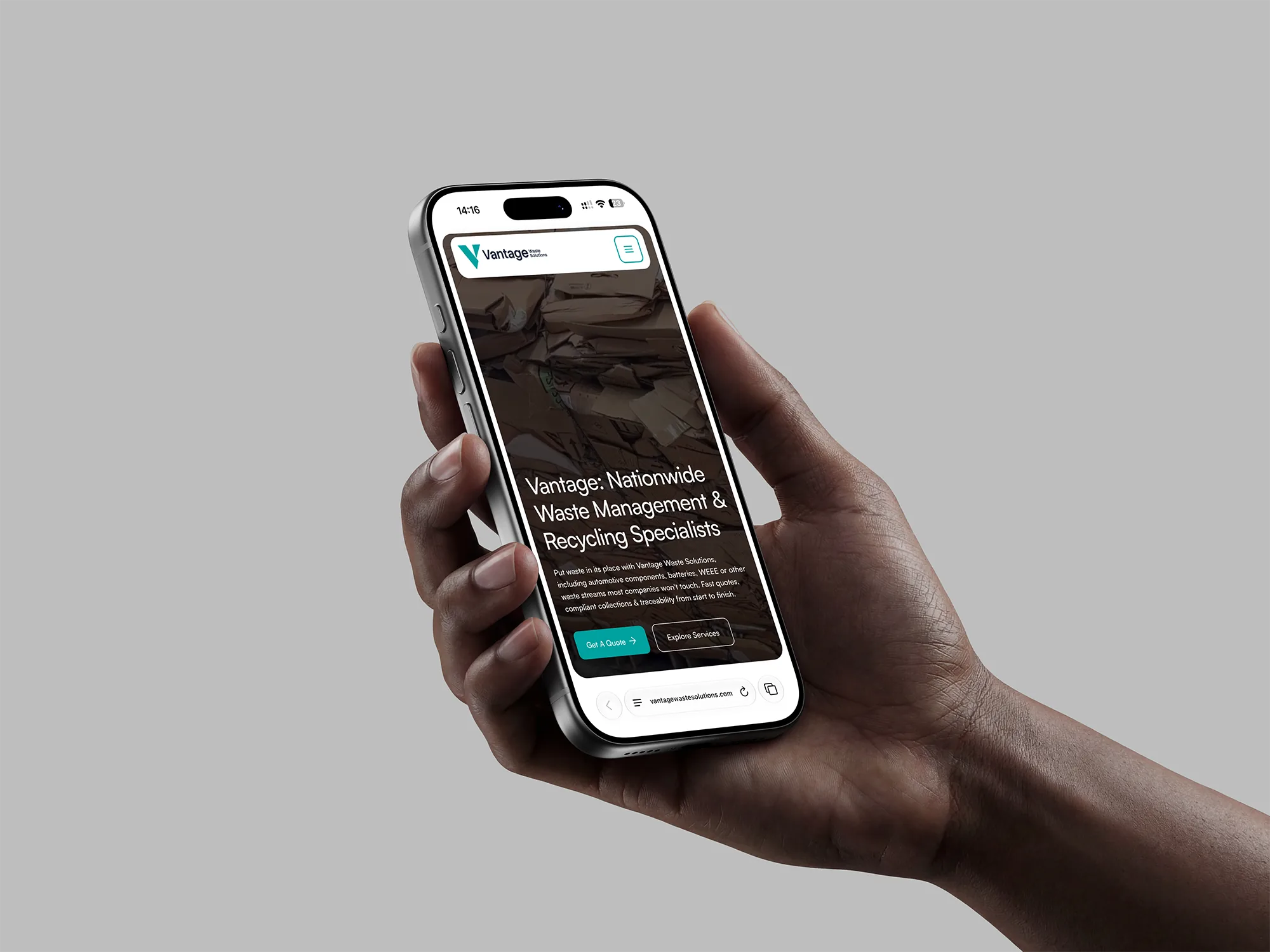
In most industries compliance is a footnote. In waste, it's often the product. Vantage handles waste streams most companies won't touch, so we built its identity around what it stands for: compliance and operational capability.
An automotive manufacturer, a waste broker and a facilities manager all buy for different reasons. One generic services page can't answer all of them, so we structure services around buyer questions and give each industry its own page.
Some firms in this sector grow by adding a parent brand over an established trading name. The new name needs to borrow credibility from the old one without confusing existing customers. That was the core challenge behind Vantage and Airbag Disposal UK.
Your fleet and your site signage reach people who may never visit your homepage. If the website looks one way and the vehicles look another, the brand never builds recognition.
Environmental technology often sells monitoring, software and data together. Realtime Sensing had an air quality sensor and a full SaaS platform behind it, but visitors couldn't tell what was on offer or who it was for.
The brief. Vantage Waste Solutions needed a brand that carried 25 years of operating credibility into lithium-ion, WEEE and secure destruction, and positioned it as the specialist those sectors call first. Vantage chose us after a selection process involving several agencies.
What we did.
That ran from the guidelines and full logo suite to presentation and document layouts, email signatures, LinkedIn banners, social layouts, the sales brochure, an A5 flyer, vehicle livery and site and office signage.
The outcome. Vantage is now positioned as the specialist operator it is. Elliot Harrison-Holt, Sales Director, said: "hydro stood out as they were committed to supporting us from the offset and invested time into ensuring their proposal covered our exact requirements."
When this approach fits. A business launching or growing a parent brand, especially one moving into new waste streams. If you only need a refresh of one page, it's more than you need.
What to check. Does the new brand appear on every surface a customer sees in a normal week? Can a new waste stream get its own page without a developer?
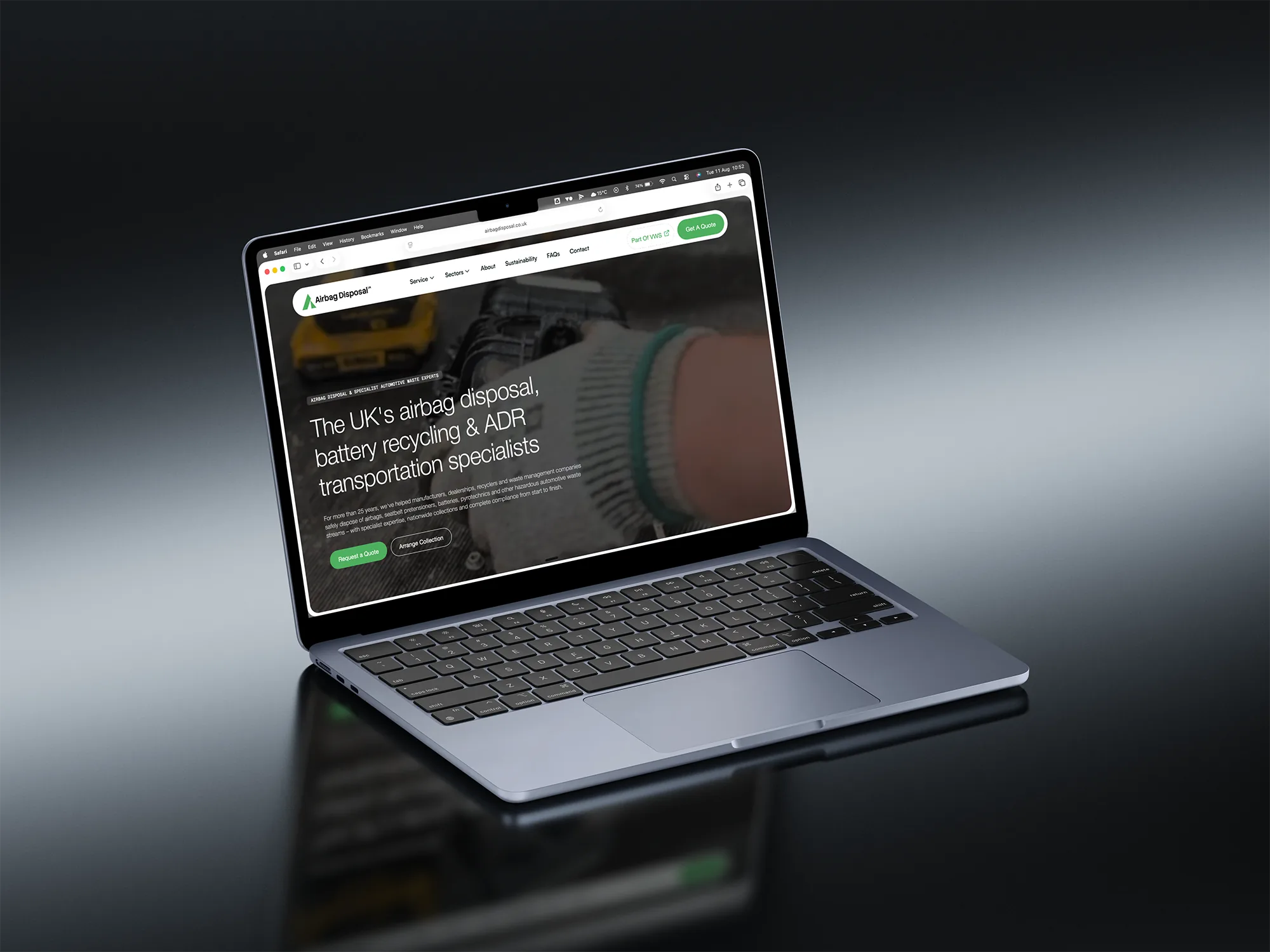
The brief. Airbag Disposal UK needed its identity evolved alongside the new Vantage parent brand. Manufacturers and waste managers needed a clear line of sight on how material is collected, transported, documented and treated across pyrotechnics, batteries and ADR transport.
What we did.
Both sites ran as one programme. We handed over greyscale wireframes for structural feedback first, then designed the homepages for sign-off before the remaining pages, while the client's content and SEO agency wrote copy in parallel so neither stream held up the other.
The outcome. Airbag Disposal UK is positioned as the specialist authority it is, with every step of the process linked to one idea: risk removed at every step. Ben Clarke, Managing Director, said: "The quality of the service and the end result represent excellent value for money."
When this approach fits. An established brand with real equity that needs to sit inside a group. Starting again from nothing would throw away years of recognition.
What to check. Can a buyer follow your process step by step on the site? Do both brands feel related without looking identical?
The brief. Realtime Sensing had developed an air quality sensor with real-time monitoring and a full SaaS platform. The website wasn't telling that story: there was confusion over what they offered, who it was for and why it mattered, and the brand felt inconsistent.
What we did.
The outcome. The site now converts better and communicates clearly. We still work with Realtime Sensing month to month on social assets and email campaigns.
When this approach fits. Environmental technology firms that sell hardware, software and data together. Good saas website design for these firms shows the platform working, not only the sensor. If buyers don't understand the product, no amount of styling will fix the enquiry rate.
What to check. Can a first-time visitor say what you sell and who it's for within one scroll? Is your data shown, or only described?
Use this checklist before you brief an agency, whether that's us or someone else.
Most projects take two to four weeks from kickoff to launch, depending on how quickly feedback comes back. Brand identity takes two to four weeks from discovery to guidelines, and Figma design for a website takes one to two weeks.
Every brief, round of feedback and file sits in the hydro portal, and we can work in your Slack. Your team gets a staging link to review before anything goes live.
Whether you're comparing a web design agency, a Webflow agency or a b2b branding agency, look for one that has explained a technical, regulated process before, and ask to see the sector pages, not only the homepage. Check whether it can carry the brand onto livery, signage and print, because that's where most of your recognition comes from. Vehicle livery design and site signage should come from the same system as the website. If you're launching a parent brand, look for a rebranding agency that also works as a brand strategy agency, so positioning and brand architecture are agreed before anyone designs a logo.
Ask how it works with your other suppliers. Some firms in this sector already have a content or SEO agency, and the project needs to run alongside them. Finally, ask what you'll own: with us, the Figma files, assets and guidelines transfer to you once the work is paid for.
Waste and environmental businesses usually run a better operation than their website suggests. Recycling company website design works when it does what your sales team does in person: walk buyers through the process, prove compliance and send each sector to the right answer. Sometimes that needs a new brand, and sometimes website redesign services on their own are enough. Either way, the brand should carry the same confidence onto every van and sign.
If your website isn't explaining what you do as well as your team does, tell us what you're working on and we'll come back with a direction, a scope and a start date. If you're weighing a rebrand first, read do you need a new website after a rebrand.
hydro is a Webflow, brand and design partner for B2B businesses, and a Premium Webflow Partner. Founded in Manchester in 2023, we're the web design agency, brand identity agency and Webflow agency behind 200+ B2B customers, rated 4.9 from 57 Google reviews. We design and build brands, Webflow websites, motion, platforms and AI agents, on our Unlimited Plan design subscription or as one-off projects, and most projects take two to four weeks from kickoff to launch. For waste, recycling and environmental businesses, that means a brand and website that explain a technical, regulated process clearly, as we've done for Vantage Waste Solutions, Airbag Disposal UK and Realtime Sensing. Contact us.
It should include a step-by-step view of how material is collected, transported, documented and treated, plus clear compliance information. It also needs a page for each sector you serve and one simple route to enquire on every page.
Yes. We built Vantage as the new parent brand and evolved Airbag Disposal UK alongside it, with a website for each. The two share one system, so they feel related without looking identical.
Yes. For Vantage and Airbag Disposal UK the brand system went onto vehicle livery, site and office signage, letterheads and document layouts. Vantage's sales brochure and A5 flyer came from the same system.
Most projects take two to four weeks from kickoff to launch, depending on how quickly feedback comes back. A brand identity takes two to four weeks from discovery to guidelines.
Yes. On Vantage and Airbag Disposal UK, the client's content and SEO agency wrote copy while we designed. We set the structure and word counts first, so their copy could be written to fit the pages.
We start with what the buyer needs to understand, then show it rather than describe it. For Realtime Sensing we used interactive design to turn complex data into clear visuals, and motion to walk visitors through use cases.
The principles are the same: say who you help, prove it and make the next step obvious. The difference in waste is the weight on process and compliance, and the number of sectors one site has to serve.
Yes. We're a Premium Webflow Partner and build on Webflow with a CMS your team can add to, so a new waste stream or sector page doesn't need a new site. Vantage's platform was built for exactly that.
hydro, founded in Manchester in 2023, designed the brands and websites for Vantage Waste Solutions and Airbag Disposal UK, and the website for Realtime Sensing, an air quality sensor and SaaS platform. Vantage chose us after a selection process involving several agencies. For Vantage and Airbag Disposal UK, the brand went from the website onto vehicle livery, signage, letterheads and document layouts.
hydro evolved Airbag Disposal UK's 25 year specialist brand alongside Vantage, its new parent brand, rather than replacing it. Most of our brand work evolves an identity rather than starting again. The two brands share one system, so they feel related without looking identical.